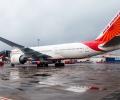
Air India group announces fuel surcharges on domestic and international flights due to rising Aviation Turbine Fuel (ATF) prices, following the government's decision to cap domestic ATF price hikes.

Air India and Air India Express are introducing a fuel surcharge on domestic and international flights due to rising jet fuel prices, impacting travel costs for passengers.

For passengers booking a return ticket between India and Singapore from Tuesday, they would be charged $100 as fuel surcharge instead of the present $110 per sector. As a result, they would gain a total of $20 for their onward and return journeys, an airline spokesperson said.
IndiGo operates 125 flights across 17 destinations with a fleet of 19 brand new Airbus A-320 aircraft. For the full service carrier, Kingfisher, the drop on flights up to 750 km will be Rs 400 to Rs 1,950 from Rs 2,350 earlier. Fares for travelling above 750 km will be down to Rs 2,700 from Rs 3,100.
Jet Airways on Wednesday said that it has raised the fuel surcharge on tickets by Rs 400 across all domestic sectors. The newly decided fares have been made applicable from June 17.
Jet Airways said on Thursday it will increase fuel surcharge by Rs 150 on both Club Premiere and Economy Class tickets on domestic routes, with effect from May 4.
Air India has decided to reduce fuel surcharge on all domestic flights by Rs 400 with effect from Tuesday.

Airfares to Southeast Asia have surged 25 to 30 per cent, driven by high demand and limited airline seat capacity.
The complaint was lodged by Mumbai-based Express Industry Council of India, which represented major express courier and cargo companies such as DTDC, Aramex India, Blue Dart, DHL Express, GATI and First Flight.

Civil Aviation Minister Ram Mohan Naidu said the reduction in airport charges is aimed at containing airfare increases and supporting both airlines and passengers.

No frills airlines SpiceJet and IndiGo have merged fuel surcharge with the base fares, saying it would simplify the prevailing fare structure.
All major airlines in the country are likely to hike the fuel surcharge by Rs 100 with effect from September 5, raising the total surcharge to Rs 750.

Prime Minister Narendra Modi has strongly refuted a media report suggesting the government is considering levying a tax, cess, or surcharge on foreign travel, calling the news "totally false".

The broader conflict in West Asia, the largest international market for Indian carriers, has forced a sharp reduction in daily flights relative to the summer schedule.

Despite reporting a weaker-than-expected net loss of Rs 2,536 crore for Q4FY26, largely due to a significant non-cash forex loss, analysts remain optimistic about IndiGo's long-term prospects, citing strong demand trends, a favourable pricing outlook, and strategic cost-control measures.

India's aviation sector is facing fresh turbulence, with rising fuel costs, the Ministry of Civil Aviation's free-seat directive, and geopolitical disruptions in West Asia clouding near-term earnings visibility.
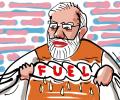
Following through announcements with enforcement of measures is key, as a run through recent Indian economic history shows, points out A K Bhattacharya.

The authority has termed it an unfair trade practice under the Consumer Protection Act, 2019, pointing out that only applicable taxes can be added to the price mentioned in the menu.

The gems and jewellery industry anticipates challenging times following the government's decision to increase gold import duty to 15 per cent, a move that exporters warn could fuel the grey market and heighten smuggling risks.

The Indian government has increased import duties on gold and silver from 6 per cent to 15 per cent to curb inbound shipments of precious metals amid a rising import bill due to the West Asia crisis.
Indian carriers have cancelled over 10,000 flights since the onset of the West Asia conflict, as escalating tensions and airspace restrictions disrupted international operations, a senior government official said.

Indian rice exporters are seeking urgent government support to mitigate the impact of shipping disruptions caused by the Iran crisis and instability in key maritime routes. The disruptions have led to increased freight rates, insurance premiums, and fuel costs, impacting domestic prices and exporter profitability.

The Indian government is considering additional relief packages for vulnerable sectors like MSMEs to mitigate the impact of the ongoing West Asia crisis on the economy and inflation.
The airport and user development fees will be kept out of it.
Following in the footsteps of Indian Airlines, Jet Airways on Friday announced a $5 fuel surcharge on all international flights originating from India.
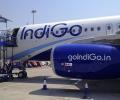
Airfares in the country are set to rise, with IndiGo on Thursday introducing a fuel charge of up to Rs 1,000 based on a flight's distance, in response to the significant rise in aviation turbine fuel (ATF) prices in the last three months. The Indian aviation sector experiences its peak travel season between October and December. The inclusion of a fuel charge component in airfares is anticipated to have a sizable impact on IndiGo's passengers, according to experts.
Owing to another rise in jet fuel prices this month, airlines, such as Spice Jet, have decided to hike the fuel surcharge levied by them on tickets by Rs 150 for short haul sectors (less than 750 kms) and by Rs 350 for long haul sectors (more than 750 kms).The fuel surcharge for short haul routes now stands at Rs 1,950 while for long haul sectors it is Rs 2,350.
Air India on Thursday increased the fuel surcharge component in fares on several routes.
According to the formula being worked out, the company would raise the fuel charge by Rs 50 for every Rs 1,000-per-kilolitre increase in the rates of jet fuel. Inversely, there would be a slide in the fares by the same amount in case of a Rs 1,000-per-kl decrease.
GoAir recently introduced return zero fare tickets under 'GoHappy Fares' plan, while low-cost arm of Air India, Air India Express offered domestic travellers a fare of Rs 99 plus taxes. Air Deccan, which has been taken over by Kingfisher Airlines and Spicejet are already in the race offering such sops. For AI Express, which has been primarily operating on international routes, this is an effort to reach out to the domestic market.
Aviation industry sources said some of the airlines were also planning to consolidate their flight schedules, by cutting some flights to certain select destinations. Indian carriers were also focusing on getting their products to a global standard and consolidating their domestic market, the study also pointed out.
As a result of crude oil prices falling to a four-year low of around $40 a barrel last fortnight, public sector oil companies today cut aviation turbine fuel (ATF) prices by 11 per cent. The rates will be effective this fortnight. The current rates were set on December 1. This is the seventh consecutive cut in ATF prices since September.

The increase has been effected from the second fortnight of this month.
Air travel became costlier on Tuesday with major Indian carriers hiking fuel surcharge on tickets, ranging from Rs 150 to Rs 250 for domestic travel and $15 (Rs 825) for a one-way international ticket, following an almost eight per cent increase in jet fuel prices.
Airline sources said an increase of Rs 600 to Rs 1,000 is necessary for all carriers to become profitable.
